Park Place Live’s mobile-friendly site will be launched shortly. In the meantime, this post will be updated with the link to the desktop site as soon as it’s live.
WHITE HOUSE:
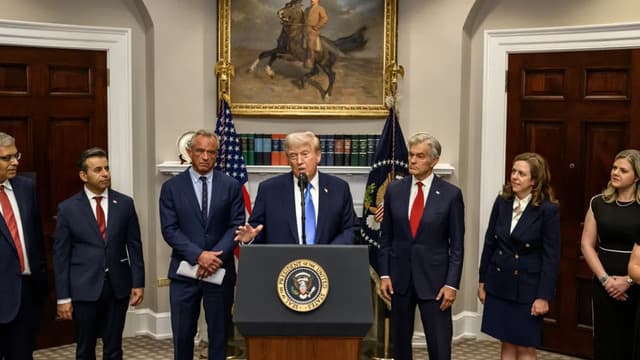
Over the last few weeks, the White House focused on a new trade agreement with the EU, issuing a new Executive Order to limit federal grants from being used for lobbying activities, tackling crime, both in DC and nationally, and exempting several federal agencies from collective bargaining requirements.
Two items of indirect interest:
- This has more bearing on the Congressional funding discussions and a potential government shutdown (more below), but the President announced today that he’s using a tool called a “pocket rescission” to unilaterally cancel $5 billion in foreign aid that Congress had already appropriated. The bigger issue, of course, is that funding is typically in the hands of Congress. The more the President gets involved with spending, the likelier it is to add complications to an already thorny process.
- One of the provisions in the Big Beautiful Bill was the creation of “Trump Accounts”, a new federal savings account for children that gets an initial $1,000 deposit from the federal government and allows parents to make yearly tax-free contributions to the account. They provided more details and a guide(PDF) to the accounts. This is a program that many folks will appreciate, especially since there may be opportunities for employers to contribute to the accounts of their employees. Please consult with you tax advisors.
CONGRESS:
With Congress coming back to town next week, the big question is what to do about the looming government funding deadline on September 30th. Democratic Leadership wrote a letter (PDF) to their Republican counterparts requesting a meeting to find a path forward. Adding to the pressure on Democrats is the blowback they took in March when they worked with Republicans to avert a shutdown, much to the chagrin of their base. The President’s usage of the pocket recission, mentioned above, alarmed Congressional members and further complicates matters as Democrats seek assurance that any funding deal will actually be implemented. On the other side of the aisle, Republicans are facing their own internal struggles on the thorny issue of earmarks. It’s all adding up to a tight race against the clock in the days ahead. Elsewhere in the political world:
- A few more high-profile Congressional members are heading out of Congress, including Iowa Senator Joni Ernst and Texas Democratic Congressman Lloyd Doggett (a victim of the redistricting wars in Texas).
- Many of the Members of the House Freedom Caucus, which has been a strong factor in Congressional negotiations, are also leaving.
- Here’s more than you ever wanted to know about the inner mechanics of government funding and pocket recissions.
- While the President has a strong grip on the Republican party, it’s important to note that beneath the surface there are quite a few different factions with competing priorities.
- Democrats flipped a state seat in Iowa, notable both for the fact that it’s another strong showing for Democrats in special elections and for denying Republicans a supermajority in the state’s Legislature.
- Two useful CRS reports from the last few weeks:
- R48649: a breakdown of the health provisions that are going to end during the current Congressional session, unless Congress acts to extend them.
- IF10343: an updated guide on who pays for long term services and supports (LTSS) in the United States.
AGENCIES:
CMS is looking to create a new advisory panel on how to increase efficiencies in how the federal government pays for, and delivers, healthcare with a specific focus on increasing decreasing red tape, increasing real-time reporting, modernizing MA, and improving Medicaid. The full details, including how to nominate someone, are available at the Federal Register.
CMS held a webinar for state Medicaid agencies outlining several of the details surrounding the Rural Health Transformation Program.
CMS launched a new nationwide initiative to help states crack down on ensuring that Medicaid beneficiaries are legally in the country.
Following up on the President’s Executive Order regarding homelessness, SAMSHA (the Substance Abuse and Mental Health Services Administration) announced a supplemental funding of $19M for the Community Mental Health Services Block Grant to help states meet the goals of the EO.
Amy Gleason, acting head of DOGE, and a strategic advisor to CMS, wrote an Op-Ed in support of CMS’ effort to modernize healthcare and build a more robust digital sharing network.
HHS launched a new website to track initiatives under the MAHA banner. The site, titled “MAHA in Action” is a central resource to track everything that HHS is performing under the guidance of HHS Secretary Robert F. Kennedy Jr.
The OIG at HHS did an audit on the usage of Remote Patient Monitoring (RPM) and billing practices associated with the programs. The full report is here while the summary is here (PDF).
Bloomberg is reporting that the DOJ’s investigation into United Healthcare has expanded to the billing practices at OptumRX.
FROM THE NOTEBOOK:
- A look at how Oklahoma is attempting to ease their rural healthcare workforce shortage.
- Vermont’s insurance regulator is getting involved in contract negotiations between the state’s hospitals and commercial insurers to try to lower healthcare premiums for consumers.
- Sound familiar? Kansas’ expensive struggle with contract nurses has the Legislature exploring how to build a more robust internal pipeline.
- Another hospital has dropped United Healthcare’s MA plan, with Johns Hopkins exiting the network following failed contract negotiations.
- Idaho announced a 4% cut to all Medicaid providers.
- It looks like DOGE wasn’t anywhere near as successful as they said, with savings likely totaling only $1.4 billion, a fraction of claimed savings.
- Following an intense lobbying push by tech firms, Colorado delayed the effective start date of their new AI regulatory bill to at least June 30, 2026.
- A deep dive from McKnight’s on how SNF’s cope with the challenges of caring for senior sex offenders.
- An analysis from a think tank on the rise of AI usage by federal agencies.
- We mentioned in the past that the President’s EO for Most Favored Nation status might have the unintended consequences of causing drug prices to riseelsewhere, rather than come down in the US. Well, we have our first sign of that. Eli Lilly is significantly increasing the price of Mounjaro in the UK rather than bring it down in the US. The company’s official announcement is here (PDF).
- The Kaiser Family Foundation explored the new efforts to increase interoperability and health data sharing.
- A judge allowed a class action lawsuit against Humana for its usage of AI in the denial of post-acute care to proceed.
- As part of their effort to improve PR, United Healthcare formed a new “public responsibility committee”.
- Healthcare Services Group suffered a data breach, with more than 600,000 records being exposed.