Park Place Live’s mobile-friendly site will be launched shortly. In the meantime, this post will be updated with the link to the desktop site as soon as it’s live.
WHITE HOUSE:
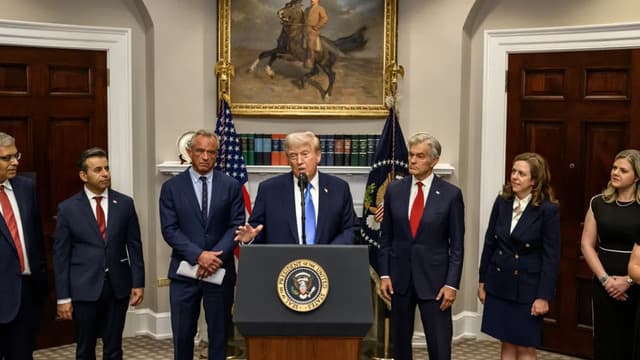
The White House focused this week on the Administration’s ongoing efforts to revamp federal procurement rules via a proposed rule that would continue to deregulate the Federal Rules of Acquisition (FAR), tackling crime in Memphis, and promoting the Administration’s public-private partnerships on AI. One item of indirect interest for us:
- The President issued a Presidential Memorandum that directs HHS to increase oversight of direct-to-consumer pharmaceutical ads to ensure that they are truthful and not misleading. The full text of the memorandum is here. While the intended target of the memo is Pharma ads, if the Administration is promoting the idea that healthcare ads need to be more truthful and transparent, hopefully that will have an impact on other advertising in healthcare.
CONGRESS:
As the clock ticks closer to the funding deadline of September 30th, it continues to look like Congress is gonna punt the federal funding deadline with a Continuing Resolution. The two big questions are timing and whether there’s enough Democratic support to get it through. As to the question of when, the White House wants a CR through January 2026, while Congressional appropriators only want one through November so that the pressure to get a real deal done remains. On the political side, Democrats are struggling on how to best use their leverage in the leadup to a government shutdown, with Senate Minority Leader Schumer publicly taking his strongest position yet on forcing a shutdown, something that House Minority Leader Jeffries also expressed. With the President publicly urging Republicans to ignore Democrats, the path forward remains rocky. Elsewhere in DC:
- The House Appropriations committee approved the HHS Appropriations Act this week. One of the amendments that was approved, with Republican support, was a provision that would prevent CMS from running a pilot program (that CMS announced earlier this year) that implemented a Prior Authorization process in several areas covered by traditional Medicare.
- Democrats picked up another Congressional seat this week, winning a special election in Virginia, further limiting the slim Republican majority.
- Welcome to the redistricting club, Missouri! The state passed a new Congressional map that should net the GOP one more seat in the midterms. Meanwhile, Democrats are facing internal pushback on redrawing blue state maps to counteract the GOP efforts. Redistricting efforts are also facing litigation. NCSL has a good rundown of mid-decade redistricting.
- A national Super PAC is investing more than $1 million in an ad buy to support the Republican candidate for the NJ gubernatorial race.
- Senator Ted Cruz introduced a new framework for federal AI regulation, called the Sandbox Act, and the White House’s Office of Science and Technology Policy director Michael Kratsios publicly supported it. The full text is here(PDF), the summary is here, and the one pager is here.
- To start moving the President’s nominees forward, the Senate invoked the “nuclear” option (that lowers the threshold to a simple majority, as opposed to 60 votes).
- One interesting CRS report from the week: a guide to Congressional offices on the latest in litigation surrounding the 340B drug program.
AGENCIES:
CMS revised their recent QSO regarding changes to Care Compare, delaying implementation of the long-stay antipsychotic measure to January 2026. The QSO is here (PDF).
CMS Director Dr. Oz posted a video to his X account announcing the launch of the $75 million fund to help shore up SNF staff.
Following up on a few provisions within the One Big Beautiful Bill, CMS sent out guidance (PDF) to state officials on how they must be calculated. Fierce Healthcare has a good summary. CMS also sent out an “Informational Bulletin” (PDF) on how the programs should be evaluated.
Despite last week’s decision to let the Biden-era non-compete rule expire, the FTC sent out a notice, specifically to healthcare companies, that they plan to enforce compliance with existing laws related to non-compete clauses. An example of the letter is here (PDF). They also issued a RFI to better understand how non-competes are being used. The RFI is here (PDF). A good summary of the latest on the FTC’s approach on non-competes is here.
The Department of Treasury and the GSA launched a new program, called the Savings Award for Verified Efficiencies (SAVE), that would rewards federal employees with a reward of up to 5% (capped at $10,000) for savings related to fraud, waste, and abuse in federal programs.
HHS finally released the long-awaited MAHA roadmap, with a guide on how the federal government is tackling chronic conditions. The full resource page and report is here.
The OIG at HHS performed an audit on Hawaii’s SNF’s, finding that many of them didn’t comply with federal requirements on background checks. The full report is here (PDF) and the summary is here (PDF).
The OIG at HHS also did an audit on Medicare Part B payments for wound care products, finding that there’s major concerns for fraud in the program. The full report is here (PDF) while the summary is here (PDF).
FROM THE NOTEBOOK:
- A new study in JAMA found that folks on MA typically end up with longer hospital stays than those on traditional Medicare, highlighting yet again that traditional Medicare is a better value proposition for the government. McKnight’s has a good summary.
- We’ve talked a lot about the halo effect of the One Big Beautiful Bill’s Medicaid cuts. Kaiser Health News did a deep dive into the tough decisions states are facing.
- In light of anticipated federal funding cuts, New York is ending its plan to provide zero premium healthcare coverage for working-class beneficiaries.
- At a special session in late August, Colorado’s Legislature canceled an across the board 1.5% Medicaid cut for providers, although it doesn’t appear to affect SNF’s.
- California sent a slew of bills to the Governor to sign, including new restrictions on private equity transactions in healthcare, a bill on regulating AI, and a bill regulating PBM's. The Governor vetoed similar bills last year and there’s no guarantee he’ll sign these.
- The Kansas Legislature continues to look long and hard at the state’s board of nursing.
- The end of the TPS program is potentially exacerbating the healthcare shortage.
- AI robots are on the way to help with the staffing shortage.
- A judge allowed Particle Health’s lawsuit against Epic to continue, in a case that can have repercussions for information blocking and health data sharing.
- A new study found that more than half of states are going to have a very difficult time implementing work requirements for their Medicaid programs.