Creator: Patrick Connole
Respecting Rehab Select’s International Nurse Pipeline
To say Chris Schmidt and his team will go to the ends of the earth to broaden his Alabama provider’s workforce options is to look at a globe, spin it, and put your finger on the surface to stop the rotation.
To say Chris Schmidt and his team will go to the ends of the earth to broaden his Alabama provider’s workforce options is to look at a globe, spin it, and put your finger on the surface to stop the rotation.
Wherever your finger lands is likely a place he or his leadership staff have been to in person or performed outreach to bring international nurses to Alabama to work in one of Rehab Select’s five skilled nursing and rehabilitation facilities.
Schmidt, owner and president and CEO of Rehab Select’s parent company, Schmidt Wallace Healthcare, has a story to tell on why his organization thinks bringing nurses from places like Kenya and Ghana to places like Talladega, Ala., is worth the thousands of miles, the cost, the bureaucratic red tape, and the training and assimilation processes.
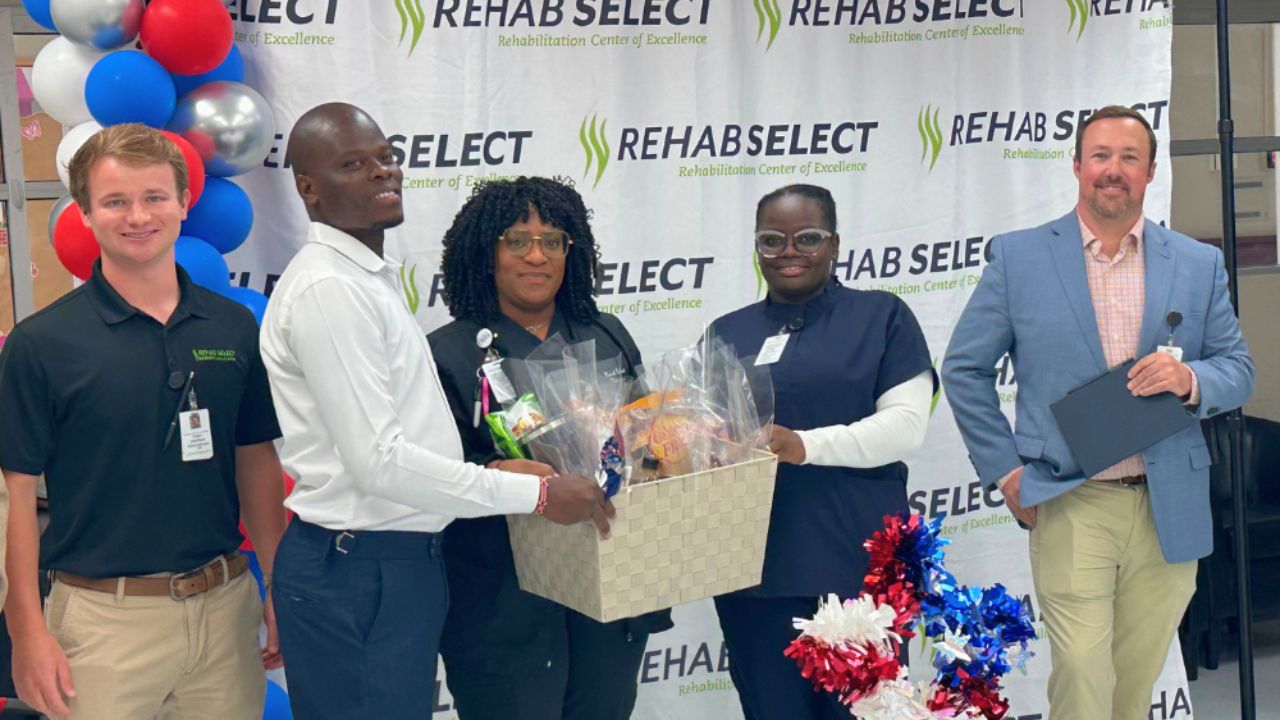
For instance, just last month, Rehab Select hosted a community welcome event in Talladega, honoring six newly arrived registered nurses from Ghana and Kenya and their families. The six nurses join three others from international locations already working within the organization, and will work at the Talladega facility, as well as facilities in Guntersville and Alabaster – all in Alabama.
To Brandon Farmer, CEO of the Alabama Nursing Home Association, or ANHA, the Rehab Select story and its international nurses reflects both the staffing challenges facing long-term care and the kind of innovative, people-centered solutions providers in his state are pursuing to meet them.
“What stands out about Rehab Select’s approach is that it goes far beyond recruitment. They are investing in people, supporting families, building community partnerships, and creating an environment where caregivers can succeed long term,” he said.
“At the end of the day, this is about ensuring residents receive consistent, high-quality care from a stable and compassionate workforce. We are proud to see an Alabama provider leading in such a meaningful way.”
Philosophies in Action
To understand what Rehab Select is doing, you have to peel a lot of layers of the onion.
“My mother started our company 40 years ago, and I've been working in our company for 39. We've always tried doing things a little unusual, doing things a little different, and doing things a little creative,” Schmidt said.
That creativity helps form one of the two main pillars for the overseas nurse program. “My mother, Patti Wallace, taught us that different cultures, different backgrounds, different countries, diversity, people from all over the place working together is a very good thing,” he said. “So, we've always tried to live up to that idea over the years.”
The other philosophy guiding the Rehab Select team is to “always grow your own. . . make your own administrators, make your own nursing directors, make your own nurse practitioners, make your own certified nursing assistants, make your own med techs, and make your own nurses,” Schmidt said.
And they do.
In order to cultivate employees and potential leaders, Rehab Select gives staff members the opportunity to move up if they want and to make more money as they progress through different work-status levels and positions or when they attain various educational degrees.
“In orientation, we tell each of the people, we have a very clear career ladder. If you think this is the right career for you, where you can go as far as you want, you can make as much money as you want, then it's up to you. I'll support you, we'll sponsor you with scholarships. We will assist you in all different kind of ways,” Schmidt said.
Rehab Select cares for 780 patients and has about 1,100 employees that do the job. “We're heavily staffed with CNAs, nurses, and therapists,” he said.
The Root Cause
Before touching on the particulars of the overseas nurses, Schmidt wants to talk about what he calls “The Root Cause.” That is to say the real problem that’s been at the doorstep of nursing homes in his state and all across the country for years.
“The root cause is obviously that there's not enough CNAs available for everybody. There's not enough LPNs available for everybody. There's not enough RNs available for everybody. And the pandemic made it worse and put everybody in a crisis situation. People just had to survive and do things they're not used to doing, and so we had to come up with some survival strategies that I've shared with others,” Schmidt said.
Taking a Piece of the Pie
His main message to other owners and operators is to look at a pie, like an apple pie, “a good southern Alabama apple pie generally, and see that the traditional model is for me to do better, you've got to do worse.”
In other words, for one facility to be fully staffed, “I've got to take from you. I've got to steal from you. I've got to recruit from you. What we're doing is this, I'm taking your piece of the pie to get my piece of the pie. Right. And I think that's absolutely the wrong approach,” Schmidt said.
The better way is to make the pie larger by expanding the worker pool, which Rehab Select has helped to do over the years to create a nursing school program in conjunction with the Alabama Department of Education, producing CNAs educated and ready to fill open slots in nursing homes in the state.
“We produce about 10 CNAs per class at four schools, so that's going to be somewhere around 800 to 900 CNAs per year, every year,” Schmidt said.
And that’s just one of his company’s efforts in building the clinical and even non-clinical staffing pipeline, which eventually leads to the international program.
Over There to Here
Schmidt said international nurse recruiting is another part of the overall workforce program and not a panacea on its own, with local situations in Alabama helping to fuel the drive for diversity discussed earlier.
And have they been diverse.
“We've had folks from Haiti, Jamaica, Cuba. We have had folks from England and then the continent of Africa. We've got folks from Nigeria, Gambia, Ghana, from the West Coast, then from the East Coast, Uganda, Kenya, Tanzania. We currently have a person that is working through the process from the country of Malawi. So that's a first,” he said.
“And we've had folks from the Philippines who’ve worked with us, and we are working right now to get that pipeline reestablished.”
Uber Driver
Rehab Select started a lot of its outreach before the pandemic started. “As a matter of fact, we had had a trip to Africa, six of us, going there to recruit in April of 2020,” Schmidt said.
The group was able to establish “boots on the ground” through an Uber driver in the U.S. who they recognized as having an accent from East Africa. “He then goes to East Africa and does job fairs with us,” he said. Those efforts started six years ago. And just recently bore fruit.
“So, fast forward, we had about 16 people sign up to work with us and go through the process. After six long and really frustrating years, our guy crossed the finish line. His son was less than one when he started the process with this. Well, he arrived here this spring and he said his son's just turning seven. That's great. His name is Samuel and he brought his wife Rhoda with him, and she is also a registered nurse. They are here and living with us,” Schmidt said.
The processes have been sped up in more recent times, getting the recruiting process to onboarding in Alabama down to about two to three years.
Schmidt said they have now received nine nurses from different countries in Africa, West and East Coast, and they don't just bring themselves. “They bring their spouse. They bring their children. And so, when people are thinking about that, you have to think, you're not just bringing a nurse. And our program uses the EB3 program, which is basically they're getting a full green card for not only themselves, but their spouse and all of their dependents.”
Now What?
Once here, the real work starts, Schmidt said. “Our support includes housing and we bought the Alabama Institute for Deaf and Blind campus, the original campus, 20-some years ago, as a support for our largest facility in Talladega, Alabama, and this is where the folks go to live,” he said.
“We've got maybe about 35 people living across the street that are from Africa. We have a daycare on-site. They all walk to work,” Schmidt said.
Housing is set, but there is much more to organize around. Like, for instance, the nurses need support to get their Social Security cards, to get bank accounts, to enroll their children in daycare, in elementary school, and in high schools. “They have transportation needs. We bought them a community vehicle that they can use once we take them and get their driver's license,” he said.
Lefty Drivers and Hot Tea
Some of them drive on the left side of the road. But not a problem, Schmidt said.
“They have to learn to drive on the right side. We have helped them with that, and then we found a company in Birmingham to give them driving lessons,” he said.
Other considerations are religion. “Church and religion are very important to them. So, locating churches and transportation to church on Saturday or Sunday is important to these folks. And then, you know, activities, such as, where do you go to recreate. We show them the closest state park, the closest lake. We just had a group of them go to the NASCAR race at the Talladega Speedway. That was quite the eye opener there, you know, and other things just common and everyday things that we don't think of, such as when we take them to the Mexican restaurant and they try to order hot tea. Mexican restaurants don't have hot tea.”
How to Succeed
The lesson from all these examples is that if you are a provider, you have to commit to the process, get people in the pipeline, and stick to the assimilation and support plan.
“You can pay a recruiting company to do everything that we're doing, or you can do it yourself, but you need boots on the ground. But they're not too hard to find. They are all here in America and many do indeed drive for Uber. You can find people from Nigeria, Philippines, you know, all these people from different countries who know nurses who want to be here, and that's how you kind of start the process,” Schmidt said.
He suggests hiring a good immigration attorney here in the States that you work with and that way you make it more reasonable and learn the process, eventually leading to Rehab Select doing a lot of that leg work themselves.
“We pick up the person from the airport. We make sure the children’s rooms are prepared and if it's a girl, it's got to be pink and if it's a boy, it's got to be blue. When Samuel and his wife Rhoda came down the escalator at the Atlanta airport, we thought Jaden was a girl. Jaden was a boy. So, we changed that room very quickly before they drove two hours, from pink to blue,” Schmidt said.
The Rehab Select way, growing home grown nurses from 8,000 miles away.
Comments or questions? Contact Patrick Connole at pconnole@parkplacelive.com.

Senior Living Sees Hope for Middle-Income Housing Bill
