Creator: Patrick Connole
Group Triggers Debate: Are Feds Offering ‘Free Pass’ Surveys?
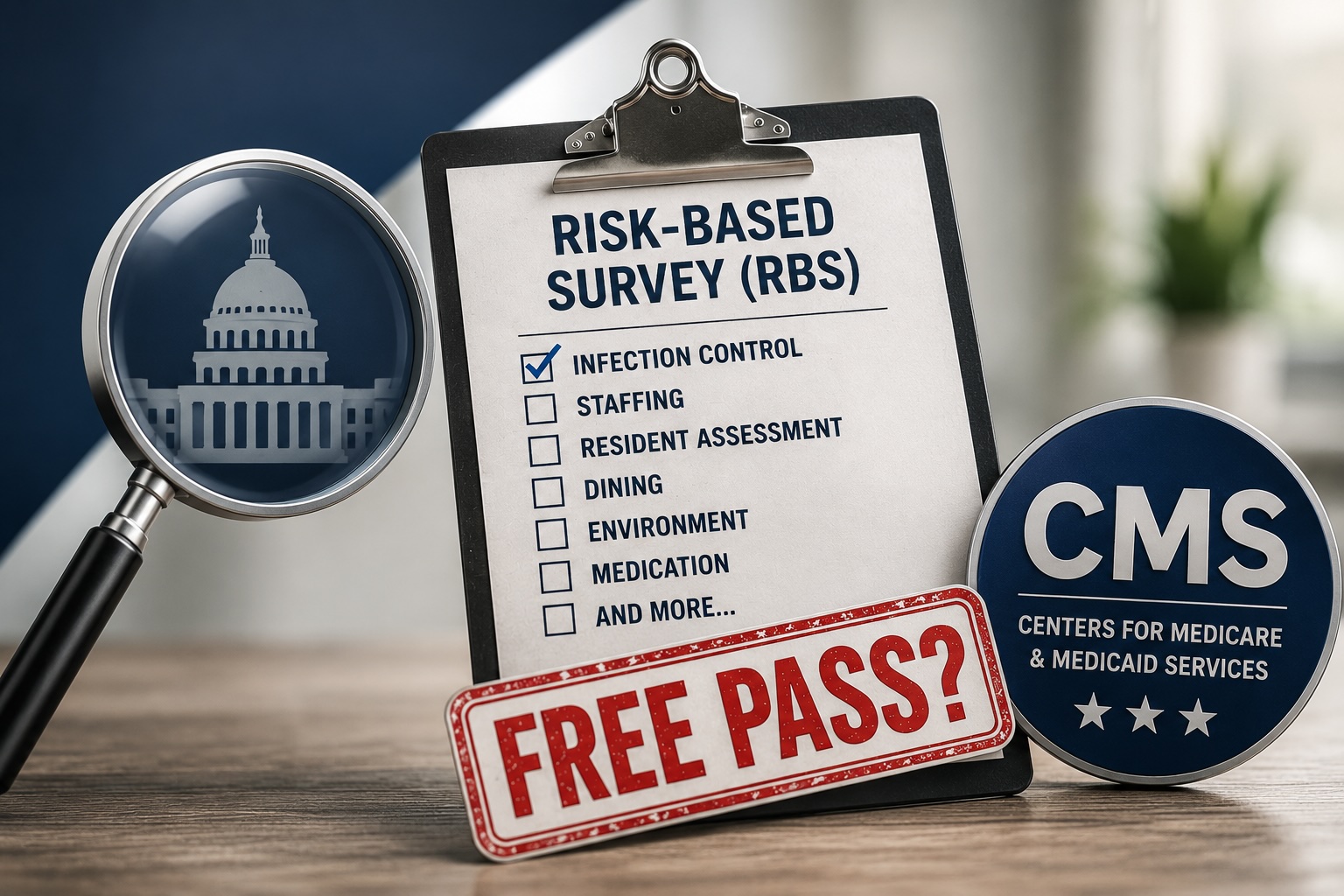
Are the new CMS plans to implement Risk-Based Surveys nationally a “free pass” for providers? Advocacy group says yes, sector expert says definite no.
Public interest group Center for Medicare Advocacy in an online post has declared that part of the CMS plan to implement Risk-Based Surveys (RBS) nationally next month defies federal statute, specifically on the content of what nursing home surveys investigate, which in turn give a “free pass” to providers.
A SNF sector expert strongly disagreed with the group’s interpretation of the new CMS survey designation. But first, the Center for Medicare Advocacy said its concerns come in two parts.
“Initial concerns about RBS centered on the new survey process’ reduced oversight of more than 1,000 nursing homes, endangering residents and undermining accountability. With limited oversight, many serious problems will never be identified and corrected. Moreover, facilities identified for RBS are selected through criteria that do not indicate ‘high performance,’” the group said.
“New guidance released in mid-August on CMS’s Nursing Home webpage creates more alarm. RBS includes the same survey tasks as the standard survey, but there are major differences in the tasks. RBS is a shorter survey [19 pages, compared to 49 pages], with fewer surveyors, fewer residents in the initial resident pool, and fewer residents in the final resident sample [whose care is reviewed by surveyors]. CMS expects that RBS will take half the time of a standard survey.”
The post said CMS’s justifications for RBS are that the survey budget has been flat for a decade and the 20 percent increase in the number of nursing home complaints received by state survey agencies. The Center said CMS argues that surveyors should spend less time in “high performers” and more time in nursing homes with quality problems. Of course, the flexible 9-15 month survey cycle set out in federal law (42 U.S.C. §§1395i-3(g)(2)(A)(iii), 1396r(g)(2)(A)(iii)) already gives state agencies the ability to focus more attention on troubled facilities, the post said.
Center Cites Statute
Further, the group said, “Significantly, the only mandatory survey task in RBS is infection control. Every other survey task is performed only if the issue is ‘triggered,’ that is, if there is a pending intake about the issue or if the issue is identified either by the ombudsman or onsite [by resident concerns or surveyor observations]. Issues not automatically reviewed in RBS include sufficient and competent nurse staffing, resident assessment, dining, environment, kitchen, resident council, medication administration, medication storage and labeling, personal funds, and SNF beneficiary notification review.”
The minimal requirements for RBS surveys appear to violate mandatory requirements for surveys, as defined in the Nursing Home Reform Act, the group added.
“The federal law requires that a standard survey be conducted for each nursing home, 42 U.S.C. §§1395i-3(g)(1)(A), 1396r(g)(1)(A), Medicare and Medicaid, respectively. The law also specifies the ‘contents’ of the standard survey.”
CMS’s POV
At issue is the CMS announcement on July 16 that introduced a more streamlined review process for higher-performing nursing homes as well as an easier way for consumers to discover them when searching the CMS website.
The Quality, Safety, & Oversight (QSO) Memo outlines this RBS process that strategically directs state agencies’ limited resources where they are needed most — by focusing fewer resources on the nation’s higher-performing nursing homes so states can address issues in nursing homes where residents’ health and safety are at greater risk, the agency said.
CMS said to identify these higher-performing facilities, the agency will place an icon on the Care Compare tool on Medicare.gov.
“Building on a successful pilot program conducted across 22 states, the new risk-based survey process is designed to improve efficiency and effectiveness in nursing home oversight,” CMS said. “This approach reduces both the time required and the number of staff members needed to conduct standard recertification surveys at the higher-performing facilities in the country.”
The Expert Clarifies
In answer to the “free pass” discussion by the advocacy group, Steven Littlehale, chief innovation officer, Zimmet Healthcare Services Group, said he does not view it that way.
“It is an earned, conditional approach to survey oversight for facilities that meet CMS’s established criteria,” he said. “Importantly, the Requirements of Participation have not changed. Facilities remain responsible for meeting the same federal standards of care and compliance. If surveyors identify concerns during an RBS that warrant broader investigation, the survey can expand accordingly.”
Littlehale said, “Nor does a facility simply retain RBS status indefinitely. If it no longer meets the eligibility criteria, it no longer qualifies for the risk-based approach and is subject to the traditional survey process.”
“And RBS does not insulate a facility from complaint oversight. Complaints and facility-reported incidents continue to be investigated as required.”
He said there is certainly room for thoughtful debate about whether the RBS methodology provides sufficient oversight.
“But describing it as a ‘free pass’ misses an important distinction: RBS does not eliminate regulatory requirements, it adjusts the intensity of the standard survey for facilities whose performance has earned that distinction,” Littlehale said.
CMS had no response to a query on this article. Learn more about RBS here.
Comments? Contact Patrick Connole at pconnole@parkplacelive.com.